
Author: Gani Nasirov | www.ganinasirov.com
Prelude: The Art of Waiting
At a roadside shelter, you practice a small discipline: patience and noticing. In this pause, your worried mind stops demanding you to be efficient and simply asks you to be present with strangers or neighbors who have been sharing similar and perhaps different journeys.
Here, the ordinary becomes a ritual: a glance down the road, a shrug, a smile or maybe wishful thoughts of seeing village girl you are secretly in love with. The shelter is both stage and sanctuary, a small architecture for a common feeling.
And there is memory. These stops have watched decades of seasons, departures to factories and schools, returns with bread and news. To pause under their arches is to borrow that memory for a moment. You inherit a lineage of waiting—patient, stubborn, quietly hopeful. The art is not about counting every second but expecting unexpected encounter in meantime. When the bus finally arrives, you step on. Your eyes are rinsed by noticing. You have something special that’s humble but very valuable.
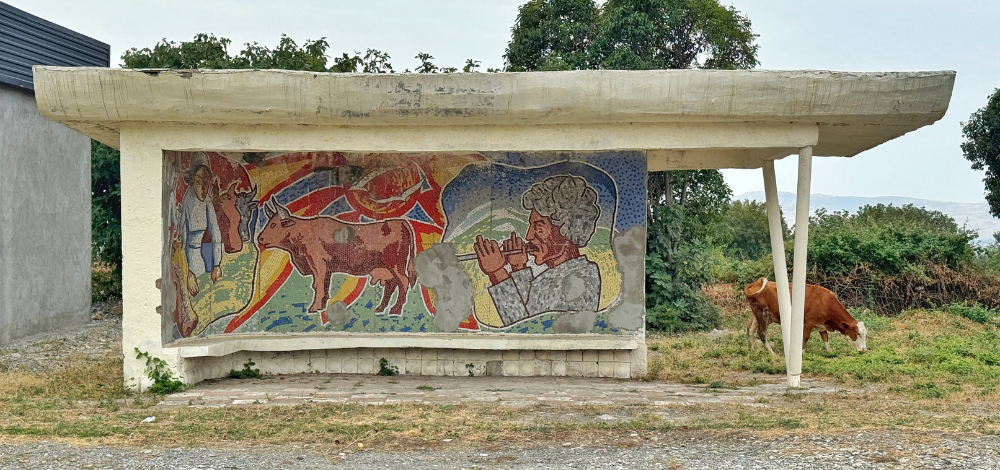
Bus Stops: Small Canvases of Imagination
Across Azerbaijan’s towns, villages, and dusty highways, fragments of Soviet-era design still stand quietly by the roadside: bus stops and mosaics. These seemingly ordinary structures tell stories about a vanished era, when architecture, art, and ideology were woven into the fabric of daily life.
In the Soviet Union, bus stops were never just utilitarian shelters. Especially in the 1960s–1980s, architects and artists experimented with sculptural forms, vibrant tiles, mosaics and modernist motifs to turn these roadside stations into unexpected landmarks.
In Azerbaijan, bus stops often reflected local traditions and landscapes. Some were built with forms reminiscent of socialist symbolism, others with pointed arches that hinted at Islamic architecture. Along highways in regions such as Shamakhi, Guba, Ganja or Lankaran, one can still find stops adorned with bold geometric designs, seashell-shaped concrete roofs, or colorful ceramic panels. They served not only as waiting places but as markers of identity within the standardized Soviet landscape.
Mosaics: Narratives in Stone and Glass

Mosaics were a central part of Soviet decorative art, used to celebrate industry, agriculture, and the “friendship of peoples.” In Azerbaijan, these mosaics often blended socialist realism with local color. Grapevines, pomegranates, oil rigs, Caspian fish, and folkloric figures all found their way into bus stop walls, cultural centers, and factory facades.
Unlike paintings, mosaics were durable—meant to withstand the sun, rain, and decades of use. That resilience is why many of them, despite neglect, still survive. A mosaic in Sumgayit might celebrate metallurgy; one in Ganja might depict heroic and utopian personalities of Nizami’s ‘Khamsa‘. Even small villages boasted panels that reminded passersby of the collective vision of progress and unity.
Between Functions and Monument
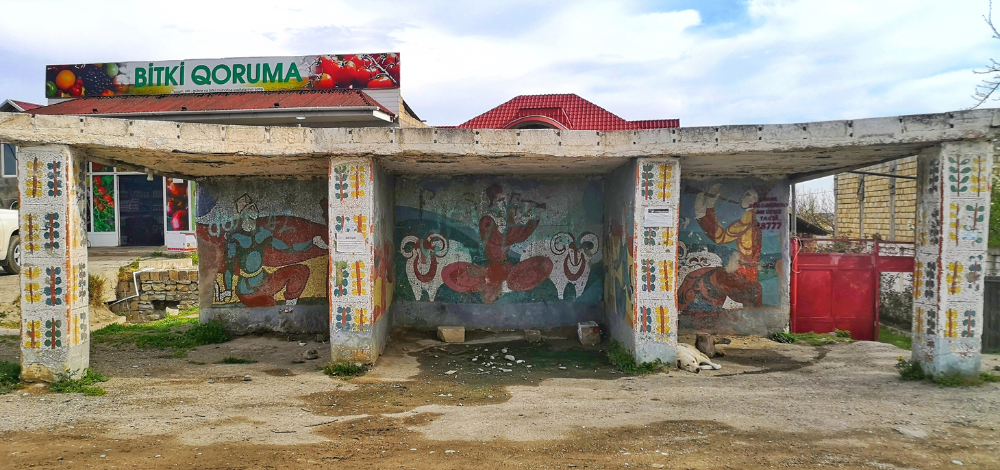
What makes these structures fascinating today is their dual role: at once practical and symbolic. To a farmer waiting for the morning bus in 1975, a brightly tiled stop offered shade and a sense of pride; to the traveler today, it is a relic, a fragment of an artistic and ideological world that has disappeared.
Their creators, often anonymous architects and artists, used limited means to leave behind works of imagination. With a few square meters of concrete and colored glass, they produced something striking, memorable, and lasting.
Preservation and Rediscovery
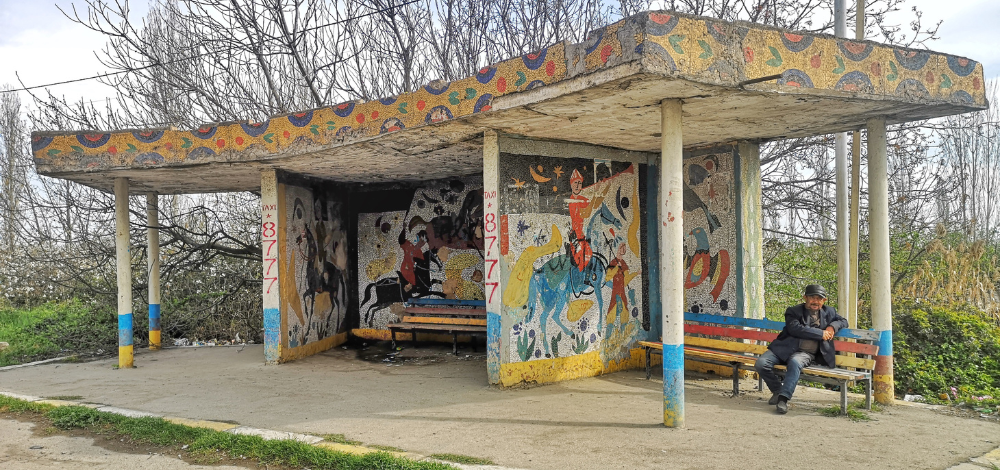
Since Azerbaijan’s independence, many of these bus stops and mosaics have fallen into disrepair. Some were demolished during road expansions, others painted over or left to crumble. Yet interest is growing among photographers, historians, and cultural enthusiasts who see in them a unique heritage. International projects—such as Christopher Herwig’s documentation of Soviet bus stops—have drawn attention to the extraordinary creativity hidden in these modest structures.
In Azerbaijan, a new appreciation is emerging: these bus stops and mosaics are not just Soviet relics but part of the country’s layered cultural landscape such as Azerbaijan Traveller’s signature excursion about Soviet monumental art and architecture. They remind us that art and architecture can flourish in the most unexpected places—on a roadside bench, under a shelter of concrete, or in a wall of shining tiles.
Conclusion
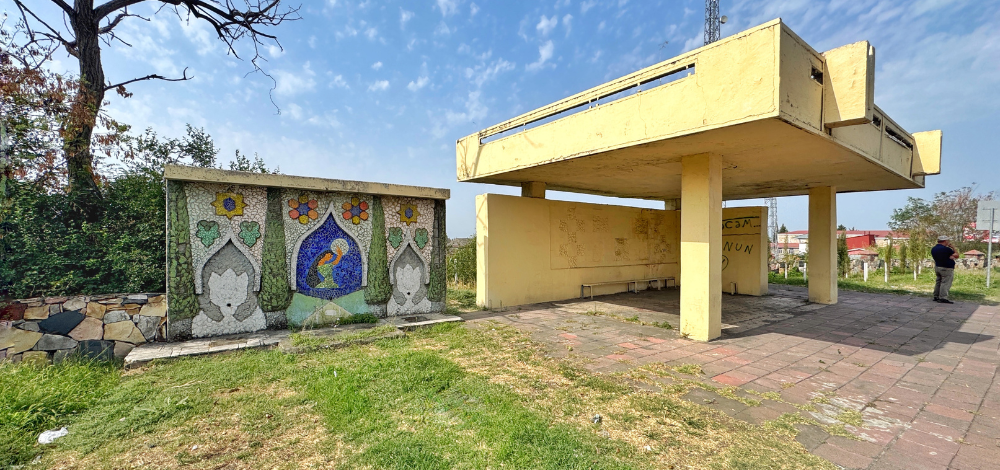
Soviet bus stops and mosaics in Azerbaijan are more than curiosities. They are small monuments of an age when ideology demanded art in everyday life, but local traditions through monumental art, i.e. mosaics or ceramic tile art, found their way into modernist forms. To study them is to read the landscape like a book, where each stop, each mosaic, holds a page of history. As time and modernization threaten their survival, documenting and cherishing them becomes a way of preserving not just architecture, but memory itself.
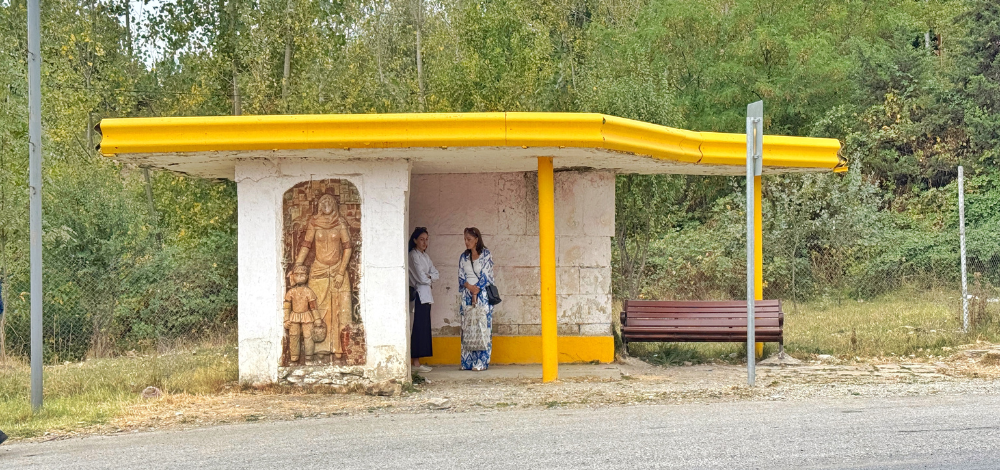
Grateful to Eldar, Anita and Nick, whose curiosity and conversation made these bus stop visits even more memorable
Related Posts You Might Enjoy:
- Soviet Architecture in Baku: Why Baku’s Socialist Modernist Buildings Are Must-Sees
- Legacy of Soviet Architecture in Baku: A Brief Historical Insight
- Soviet Mosaics of Baku: Art, Ideology, and Urban Memory
Photos & Written by: Gani Nasirov
City Guide | Writer | Urban Explorer
www.ganinasirov.com
 urban architecture blog by genii